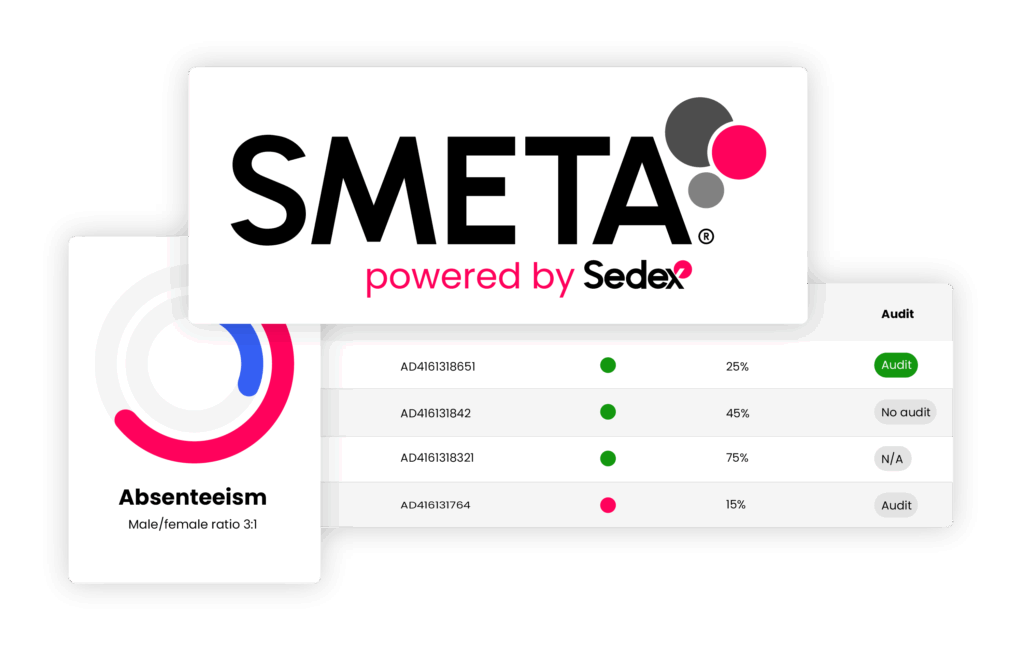
SMETA is the world’s most widely used audit. Businesses use SMETA to understand and make improvements to working conditions and environmental performance in their business and supply chain.

What is SMETA?
- SMETA (Sedex Members Ethical Trade Audit), created and stewarded by Sedex, is the world’s most widely used social audit. It helps you understand the standards of labour, health and safety, environmental performance, and ethics within your own operations or at a supplier site.
- Delivered by one of our approved auditor companies, you or your supplier is provided with a Corrective Action Plan to help improve performance in these areas.
- The SMETA audit is designed to help protect workers from unsafe conditions, overwork, discrimination, low pay, and forced labour.
SMETA's four pillars
Every SMETA audit assesses Labour Standards and Health and Safety, the two founding pillars. Most buyers now choose the full 4-Pillar audit, adding Environment and Business Ethics, used in around 70% of SMETA audits today.
Labour standards
SMETA has assessed labour rights since 2004, its founding pillar. Every audit checks fair treatment, safe recruitment, and workers’ rights on site, giving buyers a standardised, comparable view across every supplier, wherever they are.
Health and safety
Assessed alongside labour rights from day one. SMETA identifies the physical and mental risks workers face on site, so issues get caught and corrected before they become injuries, incidents, or turnover.
Environment
Added to SMETA to reduce audit duplication further, using auditors already on site. You get environmental risk data, waste, water, energy, alongside labour and safety findings, from a single visit.
Business ethics
Assessed alongside Environment in a 4-Pillar audit. SMETA reviews bribery, corruption, and conflict-of-interest risk at site level, extending your due diligence coverage without commissioning a separate assessment.
Why Sedex created SMETA
SMETA grew out of the Ethical Trade Initiative, when a group of UK retailers came together to replace their own separate, inconsistent audit processes with one shared, standardised methodology. It took three years to build, and launched in 2004. Sedex has kept developing it ever since, including SMETA 7, its biggest overhaul in the methodology’s 20-year history.

Benefits of SMETA for your business
SMETA Audits have given thousands of businesses confidence that they are working with sustainable suppliers.
Increased visibility
Gain a greater understanding of the social and environmental performance of your business and suppliers
Prioritise high risks
Assess and monitor higher risk suppliers on their performance over time
Efficient supplier auditing
Data can be shared with multiple buyers, reducing the number of audits you’ll need to collect
Improve supplier performance
SMETA provides a Corrective Action Plan to help improve supplier performance and resolve issues found in the audit
Comply with legislation
SMETA audits facilitate compliance with existing and upcoming legislation
SMETA in numbers
67,000
SMETA audits carried out in 2025
120,000
+Sites registered on the Sedex Platform, 2026
250,000
SMETA non-compliances closed in 2025
Learn more



FAQs